compression
Compression Socks for Sitting All Day: What a Desk Job Does to Your Legs

Your legs don't hurt because you did too much. They hurt because you did nothing — for eight hours, in a chair.
If your ankles feel tighter at 4pm than they did at 9am, if your socks leave deeper marks by the end of the day, or if standing up after a long call takes a second before you walk properly — that's not in your head, and it isn't a sign you're unfit. It's what legs do when they're still for too long.
What sitting all day actually does to your legs
Your calf muscle doubles as a pump. Every step you take squeezes the deep veins in your calf and pushes blood back up toward your heart, against gravity. Small one-way valves inside those veins stop it sliding back down between steps.
The catch is that the pump only works when you move. Sit still and it barely fires, so blood and fluid settle in your lower legs.

This has been measured. In a 2021 study, nine healthy young men sat for eight hours straight. By the end, their calves had swollen by 2.4%, their ankles by 2.7%, fluid in the lower-leg muscles had risen by 10%, and blood flow in the foot had dropped to 61% of where it started.1
That's one working day, in young healthy people, doing nothing more strenuous than sitting.
Is this something to worry about?
For most people, no — and it's worth saying that plainly, because the internet will happily tell you otherwise.
If you've seen headlines linking desk jobs to blood clots, a 2020 systematic review of workplace vascular risk looked for that link and concluded there wasn't sufficient evidence that prolonged sitting at work causes venous thromboembolism.2 The heaviness and swelling are real. The panic isn't warranted.
What is worth paying attention to is the day-to-day cost: tired, achy legs at the end of every working day, for years.
Do compression socks help if you sit all day?
Yes — and the same study tested it. Each man wore a compression garment on one leg and nothing on the other. The compressed leg showed significantly less swelling, less fluid retention and better blood flow than the bare one.1
A graduated compression sock is firmest at the ankle and eases as it goes up your calf. That measured pressure supports the veins doing the uphill work, so your legs aren't relying on a calf pump that's barely firing.
It's not the same as a tight sock. A tight sock squeezes evenly, or digs in at the top — which concentrates pressure in one spot rather than helping flow in one direction. Compression is knit to hold a specific pressure, measured in mmHg.
One honest caveat on that study: it's small — nine people, all young, all male, wearing thigh-length garments rather than knee-highs. It's good evidence that the mechanism works. It isn't proof of what will happen to your legs specifically.
What mmHg should you wear for a desk job?
- 15–20 mmHg — light. The usual starting point for a desk job. Enough to make a difference to end-of-day heaviness, comfortable enough that you'll actually keep them on.
- 20–30 mmHg — moderate. For more noticeable swelling, varicose veins, or if light compression isn't doing enough. Worth mentioning to your doctor if you're managing a circulation condition.
Higher isn't automatically better. A review of 58 studies covering more than 10,000 legs found people stuck with lighter compression far more reliably than firmer — 77% wore 25 mmHg or under consistently, against 65% for anything firmer.3 The best compression level is the one you'll actually put on tomorrow.
And you don't need a diagnosis for this to be worth doing. Most people assume compression is something you're given after something has gone wrong — but the tired legs you have at 4pm today are exactly what the everyday level is for.
Not sure where to start? How compression socks actually work walks through the basics.
What else helps when you're desk-bound
Compression supports the pump. These actually fire it:
- Get up every half hour or so. Even a walk to the coffee maker counts.
- Calf raises at your desk. Twenty, a few times a day. Nobody will notice.
- Ankle circles while you're on a call.
- Feet up for a few minutes in the evening, above heart level if you can.
- Don't cross your legs for hours — it's not dangerous, it's just not helping.
How to wear them so they work
- Put them on first thing, before fluid has had the day to settle.
- Get the size right. Measure your ankle at its narrowest and your calf at its widest. The top should sit about two finger widths below the crease behind your knee — any higher and it digs in. More on that in too tight, or worn too high?
- Smooth out any bunching. A folded band becomes a pressure point.
- Replace them. Manufacturers and clinicians generally recommend every three to six months with regular wear — the fabric loses its recoil, and a stretched sock no longer holds the pressure it was knit to.
When to get it checked
See your medical provider, or go to your nearest emergency room, if you notice:
- Swelling, pain or warmth in one leg, especially the calf
- Sudden or severe swelling
- Skin changes around the ankle — darkening, hardening, or a sore that won't heal
- Chest pain or shortness of breath
These can be signs of conditions that need prompt assessment. It's always better to be checked.
Before you start: compression isn't suitable for people with peripheral arterial disease, because it can affect the arterial blood supply.4 If you have diabetes or neuropathy, check with your doctor first.
Why we care about this
Dr. Johnny's exists because the socks people needed were socks nobody wanted to wear. Our founder, Dr. Jean Segal, spent 35 years treating venous disease — and kept seeing patients who'd been told to wear compression and quietly didn't, because it looked medical and felt worse. Ours are surgeon-designed to be the pair you'd actually choose.
Browse the full compression sock range. Free ground shipping anywhere in the continental US, with no minimum order. Compression socks are also commonly an eligible HSA or FSA expense — here's how that works.
Frequently asked questions
Do compression socks help if you sit all day?
Yes. Sitting still means your calf muscle pump barely fires, so blood and fluid settle in your lower legs. Graduated compression supports the veins doing that work. In one study, eight hours of sitting caused measurable calf and ankle swelling — and a compression garment significantly reduced it.
What mmHg compression is best for a desk job?
15–20 mmHg is the usual starting point — enough to ease end-of-day heaviness, comfortable enough to wear all day. 20–30 mmHg suits more noticeable swelling or varicose veins.
Why do my legs hurt from sitting all day?
Your calf muscle acts as a pump that moves blood back up your legs, and it only works when you move. Sitting still lets blood and fluid pool in your lower legs — which is the heavy, tight, achy feeling by late afternoon.
Is sitting all day bad for your circulation?
It measurably reduces blood flow and causes fluid to collect in your lower legs over a working day. A 2020 review found insufficient evidence that sitting at work causes blood clots, so the day-to-day discomfort is the realistic concern rather than anything dramatic.
Should I wear compression socks at my desk every day?
Many people do. Put them on in the morning, take them off at night. If you have a circulation condition, diabetes or neuropathy, check with your doctor first.
This article is general education, not medical advice, and it can't tell you what's causing your symptoms. Compression isn't right for everyone — speak to your doctor if you have peripheral arterial disease, diabetes, neuropathy or any circulation condition. If you have symptoms of a blood clot, seek medical care right away.
Sources
- Kurosawa Y et al. Effects of Prolonged Sitting with or without Elastic Garments on Limb Volume, Arterial Blood Flow, and Muscle Oxygenation — Medicine & Science in Sports and Exercise, 2021.
- Huo Yung Kai S et al. Lower limb venous and arterial peripheral diseases and work conditions: systematic review — Occupational and Environmental Medicine, 2020.
- Kankam H et al. A Summation Analysis of Compliance and Complications of Compression Hosiery — European Journal of Vascular and Endovascular Surgery, 2018.
- Boyers D et al. Automated devices for identifying peripheral arterial disease in people with leg ulceration — Health Technology Assessment (NIHR), 2024.
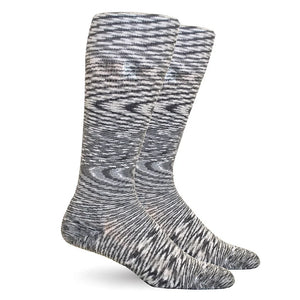
Recommended by Dr. Johnny's
Compression Socks
Surgeon-designed for comfort and healthy circulation — with free shipping on all orders within the continental US.
Shop Compression Socks →About the author
Haylie Segal is co-founder and CMO of Dr. Johnny's. She spends her days talking to the people who actually wear compression — nurses, shift workers, and anyone stuck at a desk — and writes the practical side of leg health: what helps, what to ignore, and when to ask a doctor.
Feet-first, straight to your inbox
Practical foot-health tips from Dr. Segal. No spam — unsubscribe anytime.