compression socks
Your Compression Socks Aren't Too Tight — You're Wearing Them Too High
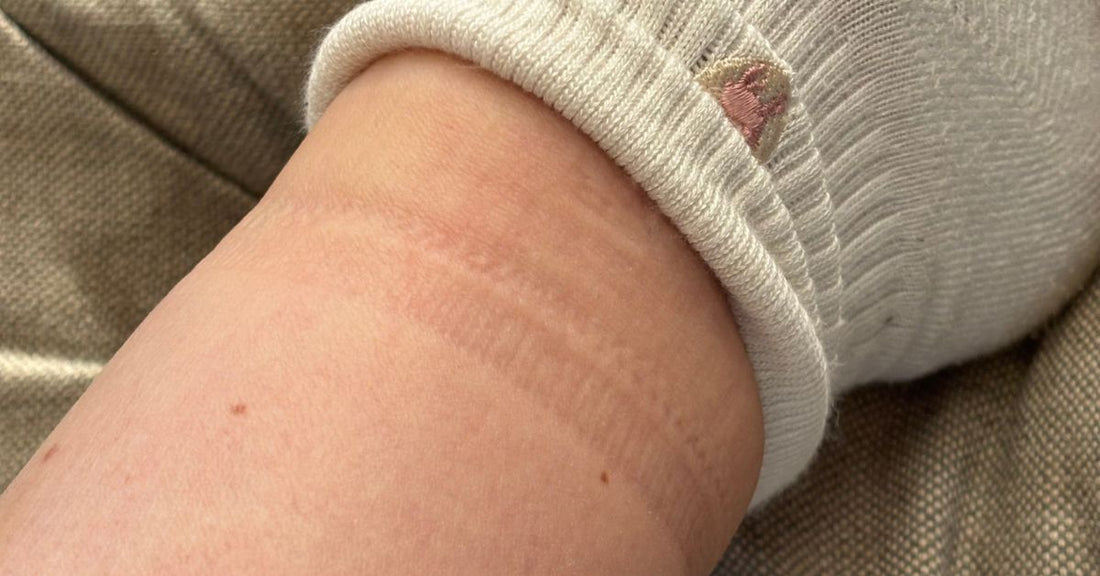
You take your socks off at the end of the day and there it is: a deep ring below the knee, maybe sore to the touch. The obvious conclusion is that the socks are too tight — it's the conclusion we hear most often; three people told us exactly that in the past two weeks. Fair enough. But in most cases the compression level isn't the problem at all. The height is: a knee-high compression sock should sit about two finger widths below the crease behind your knee, and a top pulled all the way up to the knee rolls — roughly doubling the pressure in that one narrow spot.
How tight should compression socks be?
Snug, not painful — and graduated. A properly fitted compression sock is firmest at the ankle and eases up the calf (here's how that works). You should feel steady, even pressure that lets you forget you're wearing them: no pinching, no numbness, and no single band of pressure anywhere. If one spot digs in — almost always at the top — something about the fit is off, and it's usually one of the two things below.
Can compression socks be too tight? The real culprit: the rolled top
If you pull a knee-high compression sock all the way up to the knee, the top has nowhere to go. As your knee bends through the day, the band gets pushed, folds over, and rolls. And here's the part almost nobody explains: a rolled top doubles the fabric — and roughly doubles the compression — in that one narrow spot. That's the deep ring. That's the soreness behind the knee. It isn't the sock's compression level doing that; it's twice the compression concentrated exactly where the sock was never meant to sit.
How high should compression socks go? Two finger widths below the crease
Place two fingers sideways in the crease behind your knee. The top of your sock should sit just below your bottom finger — about two finger widths below the crease. That small gap gives the band a flat place to rest, so it stays put instead of folding when you bend your knee, and the pressure spreads the way it was designed to. Smooth the fabric up the leg so there's no bunching at the ankle, and you're set. (Worth a screenshot — this is the whole trick.)

How do you keep compression socks from rolling down?
Start them lower. A top that keeps rolling or sliding is usually a top that started out too high, not a sock that's lost its grip — at the right height the band has a flat place to rest and stays put through a full day of bending, walking and sitting.
Still digging in? Measure your calf
The second cause is size. Compression sock sizing runs off your calf measured at its widest point — not your shoe size. If your calf is at or above the top of a size range, the cuff will dig in no matter whose sock it is — including ours. Our fit guide walks through the measurements, and our sizes run S–XL: if your measurement falls outside that range, we'd rather tell you straight than sell you a sock that leaves a ring. Choosing between compression levels is a separate question from size — the compression guide covers both.

Should compression socks go over the knee?
Knee-high compression socks shouldn't reach the knee at all — two finger widths below the crease, as above, is the design height. Over-the-knee coverage is a different garment (thigh-high compression), sized and built for it. Pulling a knee-high past its height doesn't give you more coverage; it gives you a rolled top.
When it's not the fit
Get the height right, get the size right, and the deep ring should be gone within a few wears. Light, brief marks that fade in minutes are normal — here's what sock marks do and don't mean. But if the fit is right and deep marks still linger on both legs well after the socks come off, that's not a fabric problem — lasting rings can be fluid rather than fabric, and that's worth mentioning to your doctor.
Every pair of Dr. Johnny's compression socks is surgeon-designed with a wide, non-digging comfort top — but even the best top only works at the height it was designed for. Two finger widths. Your calves will thank you.
Frequently asked questions
How tight should compression socks be?
Snug with steady, graduated pressure — firmest at the ankle, easing up the calf — never painful, numb, or pinching in one spot. A single band of pressure at the top usually means the sock is worn too high or sized too small, not that compression is wrong for you.
Can compression socks be too tight?
Yes — most often at the top, and usually because the top is pulled to the knee and rolls, doubling the compression in one spot, or because the calf measures at or above the top of the size range. Fix the height and the size before blaming the compression level.
How high should compression socks go?
Knee-high compression socks should stop about two finger widths below the crease behind your knee — not at the knee. That gap keeps the top from folding and rolling when you bend your leg.
How do I keep compression socks from rolling down?
Start them lower: a top that sits two finger widths below the knee crease has a flat place to rest and stays put. Rolling usually means the sock started too high or the calf is outside the size range.
Why do my compression socks leave marks?
Light marks that fade within minutes are normal. A deep ring below the knee usually means a rolled top (worn too high) or a too-small size. If deep marks linger on both legs after the fit is right, mention it to your doctor.
This article is for general information and isn't medical advice. If you're concerned about lasting marks or swelling, please speak with your healthcare provider.
Recommended by Dr. Johnny's
Compression Socks
Surgeon-designed for comfort and healthy circulation — with free shipping on all orders within the continental US.
Shop Compression Socks →About the author
Dr. Jean Segal is a surgeon with more than 35 years treating venous disease, and the founder of Dr. Johnny's. He designs every sock and foot-care product to support circulation and comfort at every age.
Feet-first, straight to your inbox
Practical foot-health tips from Dr. Segal. No spam — unsubscribe anytime.